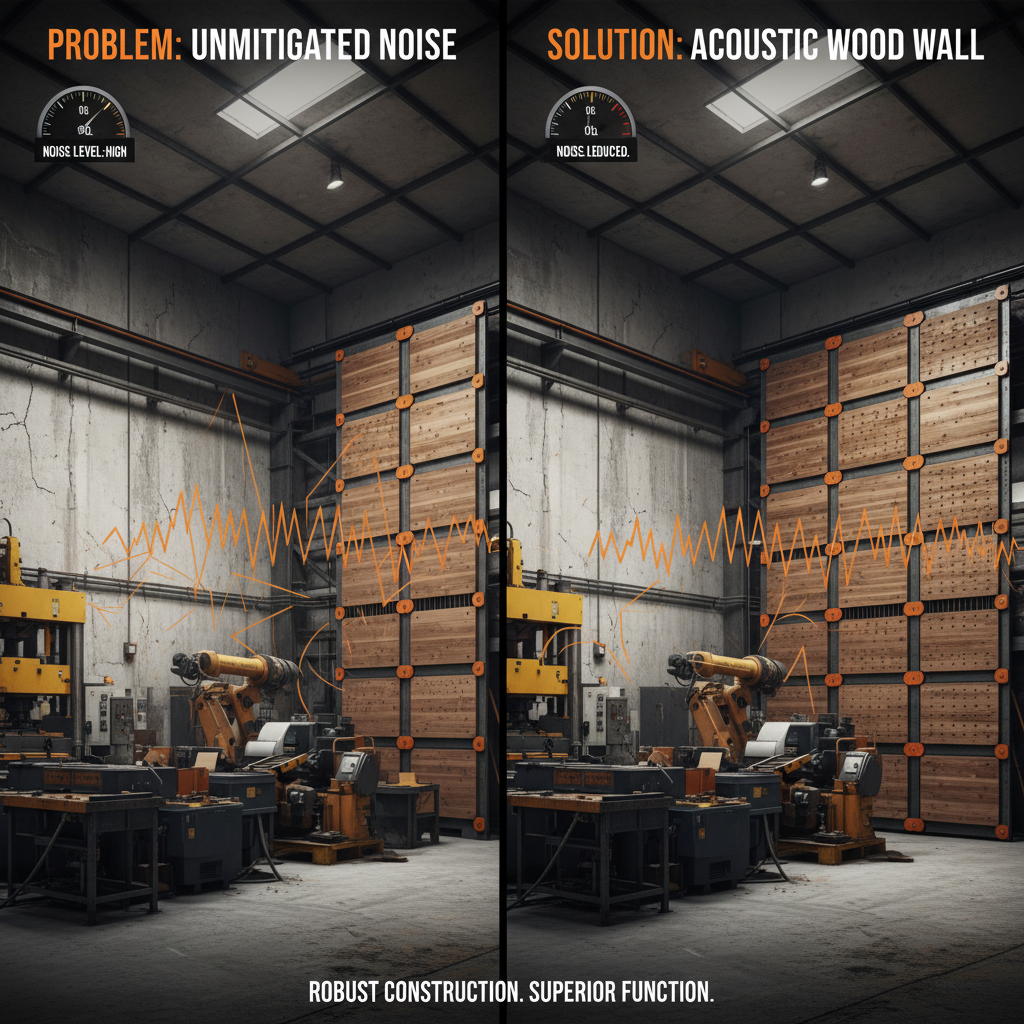
The global demand for acoustic treatment has shifted toward accessible, high-performance solutions as remote work and home-based content creation become institutionalized. Finding cheap sound absorbing panels that do not compromise on NRC (Noise Reduction Coefficient) ratings has become a primary objective for both residential users and commercial office designers.
The challenge lies in the trade-off between material density and cost. Low-cost alternatives often rely on thin foams that only address high-frequency flutter echoes, leaving mid-to-low frequency reverberations untouched. This technical gap creates a necessity for engineered polyester felt solutions that offer a balance of sustainable production and effective sound dissipation across a broader spectrum.
This analysis explores the engineering logic behind cost-effective acoustic treatment, evaluating how high-density felt constructions optimize sound quality. We will examine the selection criteria for various environments, ensuring that the pursuit of affordability aligns with actual acoustic performance and installation efficiency.


Modern acoustic panels utilize polyester fibers processed through thermal bonding to create a porous structure. This structure is critical because it converts sound energy into heat via friction as air molecules move through the fiber matrix.
By optimizing the fiber diameter and the air-gap ratio, manufacturers can produce panels that are lightweight yet highly effective at reducing reverberation in environments like KTV rooms and home theaters.
The efficacy of budget-friendly acoustic solutions depends heavily on the panel thickness and the surface geometry. While flat panels are standard, adding textures or patterns can help diffuse sound waves, preventing the "dead room" effect while still managing echoes.
Installation methods also impact overall performance. The use of self-adhesive backings, as seen in many modern polyester designs, allows for rapid deployment without the need for expensive professional adhesives, reducing the total cost of ownership for the end-user.
Furthermore, the choice of color and finish is not merely aesthetic. For commercial office cultural walls, the ability to match various decoration styles ensures that the technical requirement for sound absorption does not conflict with architectural branding requirements.
In the realm of acoustic engineering, density is the primary driver of sound absorption. Low-density materials are often too permeable, allowing sound waves to pass through without significant energy loss.
However, there is a point of diminishing returns; if a panel is too dense, it may begin to reflect sound rather than absorb it. The optimal engineering balance is found in a calibrated polyester matrix that maintains porosity while ensuring sufficient mass.
To quantify the value of budget panels, engineers use normalized scores comparing different material types. This allows buyers to see how polyester felt performs relative to more expensive industrial alternatives.
The following assessment focuses on the balance between installation ease, cost-efficiency, and frequency absorption capability across five common configuration profiles.
In a typical deployment scenario, such as a home office or podcast studio, the goal is to eliminate "slap back" echoes from parallel walls. Placing cheap sound absorbing panels at the primary reflection points (ear level) provides the highest ROI for sound quality improvement.
For commercial environments like KTVs or conference rooms, a hybrid approach combining felt panels with wooden acoustic slats can provide both broadband absorption and controlled diffusion. This prevents the room from becoming too acoustically dead, which can be uncomfortable for long-term human occupation.
The industry is moving toward circular economy principles, with an increasing focus on recycled PET (polyethylene terephthalate) for acoustic felt. This shift reduces the carbon footprint of manufacturing while maintaining the mechanical properties required for sound absorption.
Future engineering requirements are likely to demand higher fire-retardant ratings and hypoallergenic certifications without increasing the cost. The integration of smart materials that can adjust their absorption properties based on the frequency of the noise is a potential long-term R&D direction.
Moreover, the trend toward customization—allowing users to define shapes, logos, and specific density profiles—is making professional-grade acoustic treatment accessible to smaller businesses and independent creators.
Choosing the right panel requires an understanding of the specific environmental noise profile. A home theater has different requirements than an open-plan corporate office.
The following matrix provides a decision framework for selecting the appropriate configuration based on the target application and desired performance outcome.
By aligning the material density with the use case, buyers can avoid over-spending on excessive specifications while ensuring the technical needs of the space are met.
| Configuration Profile | Material Density | Absorption Focus | Recommended Use Case |
|---|---|---|---|
| Basic Profile | Low-Medium | High Frequencies | Home Decoration / Small Room |
| Standard Profile | Medium | Mid-High Range | Office Cultural Walls |
| Performance Profile | High | Broadband | Podcast Studios / KTV |
| Industrial Profile | Extra High | Low-Mid Range | Conference Rooms |
| Hybrid Profile | Variable | Diffusion + Absorption | Home Theaters |
| Custom Profile | Spec-Based | Targeted Frequencies | Professional Control Rooms |
Sound absorbing panels, such as high-density polyester felt, are designed to reduce reverberation and echo within a room by absorbing sound energy. Soundproofing, conversely, aims to block sound from entering or leaving a space, which requires high-mass materials like mass-loaded vinyl or specialized drywall. Budget acoustic panels are primary tools for internal sound quality improvement rather than external noise isolation.
A general engineering rule of thumb is to cover 20% to 30% of the wall surface area to significantly reduce echo. For more critical environments like recording studios, this can increase to 50% or more. It is more effective to distribute panels across multiple walls at reflection points than to cluster them in one single area.
Yes, the absorption capability is a property of the material density and structure, not the mounting method. Self-adhesive backings provide a convenient and cost-effective installation process that does not compromise the NRC rating of the panel. However, for permanent industrial installations, mechanical fasteners may be preferred for long-term structural security.
Low-frequency sounds (bass) have longer wavelengths and are harder to absorb than high-frequency sounds. While high-density felt panels are better than thin foams, true bass control usually requires "bass traps" placed in room corners. Combining high-density panels with corner treatments is the most effective strategy for balanced acoustic control.
Professional-grade polyester felt panels are designed to be safe to touch and breath. Many manufacturers ensure their products pass SGS verification and testing to guarantee they do not emit harmful VOCs, making them suitable for bedrooms, home offices, and children's play areas where air quality is a priority.
Many professional manufacturers offer OEM and ODM services, allowing for customization of shapes, logos, and colors. Because these panels are produced using thermal bonding and precision cutting, they can be adapted to any design requirement without affecting the core acoustic properties of the polyester fiber.
The transition toward high-density polyester felt has effectively democratized professional acoustic treatment. By understanding the correlation between material density and frequency absorption, users can implement cheap sound absorbing panels that provide genuine technical value rather than mere aesthetic appeal.
Ultimately, the goal of any acoustic project is to balance clarity with comfort. Whether deploying panels in a corporate conference room or a home studio, the priority should remain on high-density specifications and strategic placement. This ensures a sustainable, cost-effective environment that meets the rigorous auditory demands of modern professional and personal spaces.

 Afrikaans
 Albanian
 Amharic
 Arabic
 Armenian
 Azerbaijani
 Basque
 Belarusian
 Bengali
 Bosnian
 Bulgarian
 Catalan
 Cebuano
 Corsican
 Croatian
 Czech
 Danish
 Dutch
 Esperanto
 Estonian
 Finnish
 French
 Frisian
 Galician
 Georgian
 German
 Greek
 Gujarati
 Haitian Creole
 Hausa
 Hawaiian
 Hebrew
 Hindi
 Miao
 Hungarian
 Icelandic
 Igbo
 Indonesian
 Irish
 Italian
 Japanese
 Javanese
 Kannada
 Kazakh
 Khmer
 Rwandese
 Korean
 Kurdish
 Kyrgyz
 Lao
 Latin
 Latvian
 Lithuanian
 Luxembourgish
 Macedonian
 Malgashi
 Malay
 Malayalam
 Maltese
 Maori
 Marathi
 Mongolian
 Myanmar
 Nepali
 Norwegian
 Norwegian
 Occitan
 Pashto
 Persian
 Polish
 Portuguese
 Punjabi
 Romanian
 Russian
 Samoan
 Scottish Gaelic
 Serbian
 Sesotho
 Shona
 Sindhi
 Sinhala
 Slovak
 Slovenian
 Somali
 Spanish
 Sundanese
 Swahili
 Swedish
 Tagalog
 Tajik
 Tamil
 Tatar
 Telugu
 Thai
 Turkish
 Turkmen
 Ukrainian
 Urdu
 Uighur
 Uzbek
 Vietnamese
 Welsh
 Bantu
 Yiddish
 Yoruba
 Zulu
 English