
Introduction to Advanced Acoustic Solutions
In contemporary architectural and interior design, the integration of effective acoustic management with sophisticated aesthetics is paramount. Modern spaces demand not only visual appeal but also functional acoustic performance to foster productivity, comfort, and well-being. This imperative has driven significant innovation in material science and design, leading to advanced solutions that seamlessly blend form and function.
One such innovation is the Flexible Tambour Panels Sound Insulation 3D Wooden Slat Wall Panel Acoustic Panels. These panels represent a cutting-edge approach to environmental sound control, combining the timeless elegance of wooden slats with highly effective sound absorption properties. Their flexible nature allows for diverse applications, from enhancing speech intelligibility in bustling commercial environments to creating serene, acoustically balanced residential spaces. This detailed analysis will explore their technical aspects, application versatility, and the tangible benefits they offer to B2B stakeholders in various industries.
Industry Trends and Market Dynamics in Acoustic Design
The global market for acoustic solutions is experiencing robust growth, driven by increasing awareness of the impact of noise pollution on health and productivity. Key trends include:
- Sustainable Materials: A rising preference for eco-friendly, responsibly sourced materials, such as FSC-certified wood and recycled PET felt, which minimize environmental impact without compromising performance.
- Biophilic Design Integration: Incorporating natural elements and patterns to foster a connection with nature, enhancing occupant well-being. Wooden slat panels naturally align with this trend.
- Multi-functional Aesthetics: The demand for acoustic panels that double as decorative elements, offering both sound control and visual appeal.
- Flexibility and Customization: Architects and designers require solutions that can adapt to unique spatial geometries and aesthetic visions, driving demand for flexible, customizable products.
- Performance-Driven Standards: Stricter building codes and corporate wellness initiatives (e.g., WELL Building Standard) mandate superior acoustic performance, measured by metrics like Noise Reduction Coefficient (NRC) and Sound Transmission Class (STC).
The market for acoustic panels, specifically those incorporating sustainable and aesthetic elements, is projected to grow significantly, with a compound annual growth rate (CAGR) exceeding 5% in the coming years. This growth underscores the critical role of innovative products like Flexible Tambour Panels Sound Insulation 3D Wooden Slat Wall Panel Acoustic Panels in meeting evolving industry demands.
Technical Specifications and Composition
The efficacy of Flexible Tambour Panels Sound Insulation 3D Wooden Slat Wall Panel Acoustic Panels stems from their meticulously engineered composition. These panels are typically constructed from high-quality wooden slats mounted on a flexible, sound-absorbent backing material.
Key Components:
- Wooden Slats: Crafted from various wood species (e.g., MDF with veneer, solid wood like oak, walnut, or beech), these slats are precision-cut and often feature a routed profile to enhance sound diffusion and aesthetic depth. Dimensions typically range from 27mm to 30mm width, with thicknesses of 11mm to 13mm. Spacing between slats (e.g., 13mm to 15mm) is crucial for acoustic performance.
- Acoustic Felt Backing: A dense, porous material, commonly made from recycled PET felt (e.g., 9mm thick), adhered to the rear of the slats. This backing is vital for absorbing sound waves, particularly in mid-to-high frequencies, preventing reverberation. Its inherent flexibility allows the entire panel to be curved or fitted to uneven surfaces.
- Adhesive System: High-strength, environmentally friendly adhesives are used to bond the slats to the felt backing, ensuring durability and preventing delamination over time. These adhesives are often low-VOC (Volatile Organic Compound) to meet indoor air quality standards.
Acoustic Performance Metrics:
- Noise Reduction Coefficient (NRC): Measures the amount of sound energy absorbed when striking a particular surface. High-quality Flexible Tambour Panels Sound Insulation 3D Wooden Slat Wall Panel Acoustic Panels typically achieve NRC ratings between 0.65 and 0.85, indicating significant sound absorption. This is determined by testing in reverberation rooms according to ASTM C423 standards.
- Sound Absorption Class: Often categorized from A to E, with Class A representing the highest absorption. These panels frequently achieve Class B or C, depending on thickness and installation method (e.g., with an air gap behind the panel).
- Fire Safety Ratings: Materials are selected to meet stringent fire safety standards, such as ASTM E84 Class A or EN 13501-1 B-s1, d0, ensuring suitability for commercial and public spaces.
| Parameter | Specification | Standard/Note |
|---|---|---|
| Panel Dimensions (Typical) | 2400mm (L) x 600mm (W) | Custom lengths available |
| Slat Material | MDF (Medium Density Fiberboard) with real wood veneer (e.g., Oak, Walnut) | FSC-certified options available |
| Slat Dimensions | 27mm (W) x 11mm (D) | |
| Slat Spacing | 13mm (gap between slats) | |
| Acoustic Felt Backing | 9mm thick Recycled PET Felt | Color options: Black, Grey |
| Overall Panel Thickness | 20mm (11mm slat + 9mm felt) | |
| Noise Reduction Coefficient (NRC) | 0.65 - 0.85 (depending on installation) | Tested per ASTM C423 |
| Fire Rating | Class A (ASTM E84) / B-s1, d0 (EN 13501-1) | |
| Environmental Certification | E1 Formaldehyde Emission Standard | Ensures low indoor air pollution |
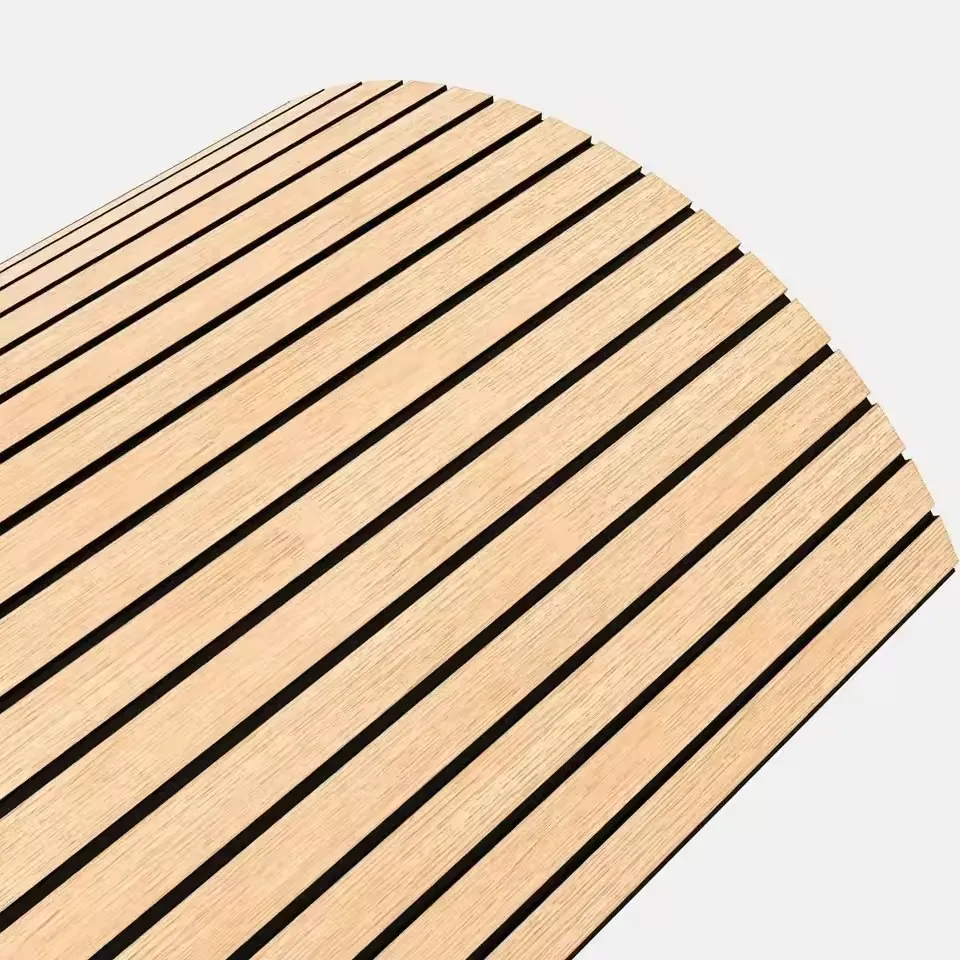
Detailed view of slat and felt backing composition.
Manufacturing Process Flow
The production of Flexible Tambour Panels Sound Insulation 3D Wooden Slat Wall Panel Acoustic Panels is a sophisticated, multi-stage process that prioritizes precision, material integrity, and acoustic performance.
Process Steps:
- 1. Material Sourcing & Selection: High-quality MDF boards or solid timber are sourced, often with FSC certification for sustainability. Acoustic felt is procured from reputable suppliers, ensuring consistent density and sound absorption properties. Adhesives are selected for environmental compliance (low-VOC) and strong bonding.
- 2. Precision Slat Milling (CNC Machining): The raw wood material undergoes precision CNC machining. This involves cutting the boards into individual slats of specific width and thickness, and routing intricate profiles if required for enhanced aesthetics or acoustic diffusion. CNC ensures exact dimensions and consistent quality across all slats, critical for uniform panel assembly.
- 3. Surface Finishing (Veneering/Laminating): For MDF slats, real wood veneers are meticulously applied using advanced laminating techniques, followed by sanding and application of protective coatings (e.g., lacquer, oil) to enhance durability, moisture resistance, and aesthetic appeal. This stage ensures the desired visual finish and longevity of the product.
- 4. Acoustic Felt Preparation: The recycled PET felt backing is cut to precise panel dimensions, often using automated cutting machines to minimize waste and ensure accuracy.
- 5. Assembly & Bonding: The finished wooden slats are carefully aligned and spaced on the acoustic felt backing. A specialized adhesive is then applied, and the components are bonded under controlled pressure and temperature. This process creates the flexible, integrated panel structure, ensuring robust adhesion and optimal acoustic performance.
- 6. Quality Control & Testing: Each panel undergoes rigorous quality checks. This includes visual inspection for defects, dimensional accuracy verification, and random sampling for acoustic performance testing (e.g., in-house reverberation chamber tests or sending samples to third-party labs for ISO 354 and ASTM C423 compliance). Fire ratings are verified through material data sheets and periodic external testing (e.g., ASTM E84, EN 13501-1).
- 7. Packaging & Dispatch: Finished panels are carefully packaged to prevent damage during transit, typically using protective films and robust crating. They are then prepared for dispatch to clients worldwide.
Service Life and Target Industries:
Due to the high-quality materials and manufacturing processes (including CNC precision and robust bonding), these panels exhibit an impressive service life, often exceeding 15-20 years with proper installation and maintenance. They are specifically designed for diverse B2B applications, including:
- Commercial & Corporate: Offices, boardrooms, open-plan workspaces, lobbies, call centers.
- Hospitality: Hotels, restaurants, bars, event venues, reception areas.
- Educational Facilities: Lecture halls, libraries, classrooms, music rooms.
- Healthcare: Waiting areas, patient rooms (where aesthetics and comfort are valued, in non-sterile zones).
- Retail: Showrooms, fitting rooms, customer service areas.
- Residential (High-End): Home theaters, living areas, private studies.
- Cultural & Public Spaces: Museums, art galleries, community centers.
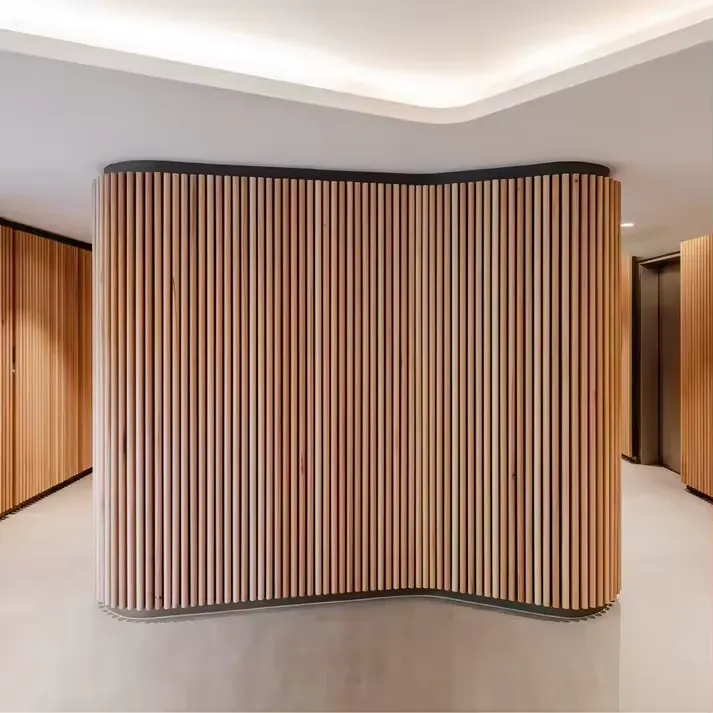
Precision manufacturing of acoustic slat panels.
Technical Advantages and Performance Benefits
The technical design of Flexible Tambour Panels Sound Insulation 3D Wooden Slat Wall Panel Acoustic Panels provides a myriad of advantages that go beyond simple sound dampening.
Core Advantages:
- Superior Sound Absorption: The combination of reflective wooden slats and the porous acoustic felt backing creates a hybrid system. The slats scatter and reflect some sound, while the felt absorbs a significant portion, particularly mid-to-high frequencies (human speech range). This reduces reverberation time (RT60), enhancing speech intelligibility and overall auditory comfort.
- Aesthetic Versatility & 3D Effect: The slat design naturally creates a dynamic 3D visual texture, adding depth and sophistication to any interior. Available in various wood veneers and felt colors, these panels can complement diverse design schemes, from minimalist modern to rustic chic. The ability to install them on curved surfaces further extends creative possibilities.
- Ease of Installation: Their flexible nature and standardized panel sizes (e.g., 2400mm x 600mm) simplify installation. They can be cut to size on-site and easily mounted using screws, adhesive, or battens, significantly reducing labor costs and project timelines compared to rigid custom panels.
- Durability & Low Maintenance: Constructed from robust MDF with veneer or solid wood, and a durable PET felt backing, these panels are resistant to impact, scratches, and general wear. The finishes are easy to clean, requiring minimal maintenance. While not designed for harsh industrial environments, they offer excellent longevity in typical indoor architectural settings.
- Environmental Sustainability: Utilizing recycled PET felt and often FSC-certified wood ensures a lower environmental footprint. Low-VOC adhesives further contribute to healthy indoor air quality, aligning with green building initiatives and certifications (e.g., LEED, BREEAM).
Advantages in Typical Application Scenarios:
- Energy Saving (Indirect): By improving acoustic comfort, these panels contribute to reduced stress and increased productivity, indirectly supporting more efficient use of space and resources. In spaces where noise reduction allows for lower ceiling heights, there can be minimal direct energy saving in heating/cooling volumes, though this is not a primary benefit.
- Enhanced User Experience: In corporate settings, improved speech clarity in meeting rooms and reduced background noise in open offices lead to higher employee satisfaction and reduced cognitive load. In hospitality, a quieter ambiance enhances guest comfort and privacy.
- Design Flexibility: The inherent flexibility allows these panels to conform to curves, columns, and other non-planar surfaces, offering design solutions impossible with traditional rigid panels. This versatility is critical for architects and interior designers seeking unique spatial expressions.
Application Scenarios and Exemplary Implementations
The versatility of Flexible Tambour Panels Sound Insulation 3D Wooden Slat Wall Panel Acoustic Panels makes them suitable for a wide array of environments where both aesthetics and acoustic performance are critical. Their ease of installation and ability to curve allows them to be used in ways rigid panels cannot.
Key Application Areas:
- Corporate Offices & Workspaces: Ideal for open-plan offices, boardrooms, private offices, and reception areas to reduce reverberation, improve speech privacy, and create a sophisticated, calming environment.
- Hospitality & Leisure: Enhancing the ambiance of hotels (lobbies, guest rooms, restaurants), bars, and lounges by controlling noise levels and adding a luxurious aesthetic touch.
- Educational Institutions: Improving acoustics in lecture halls, libraries, music rooms, and common areas, facilitating better concentration and learning.
- Healthcare Facilities: Used in waiting rooms, corridors, and non-clinical consultation rooms to reduce stress-inducing noise and contribute to patient comfort.
- Retail & Showrooms: Creating inviting and acoustically balanced spaces where customers can comfortably engage with products and staff.
- Residential (High-End): Perfect for home theaters, living rooms, and private studies where premium acoustics and design are desired.
- Studios & Auditoriums: Providing critical sound absorption and diffusion in recording studios, broadcasting rooms, and small performance spaces.
Exemplary Implementations:
Consider a large corporate headquarters project for a tech firm. The challenge was to mitigate noise in an open-plan office spanning over 2,000 square meters while maintaining a modern, collaborative aesthetic. By strategically installing Flexible Tambour Panels Sound Insulation 3D Wooden Slat Wall Panel Acoustic Panels on feature walls and ceilings in high-traffic zones, and wrapping curved architectural elements, the firm achieved a significant reduction in reverberation time (from 1.8 seconds to 0.7 seconds), improving employee focus and communication. The natural wood finish also contributed to a biophilic design, enhancing employee well-being.
Another example involves a boutique hotel in a bustling city center. Guests frequently complained about noise from adjacent rooms and corridors. The design team opted for these flexible panels for corridor walls and headboards in guest rooms. The panels not only absorbed ambient noise effectively but also added a warm, inviting, and sophisticated texture to the interiors, elevating the guest experience and reducing noise-related complaints by over 40%.
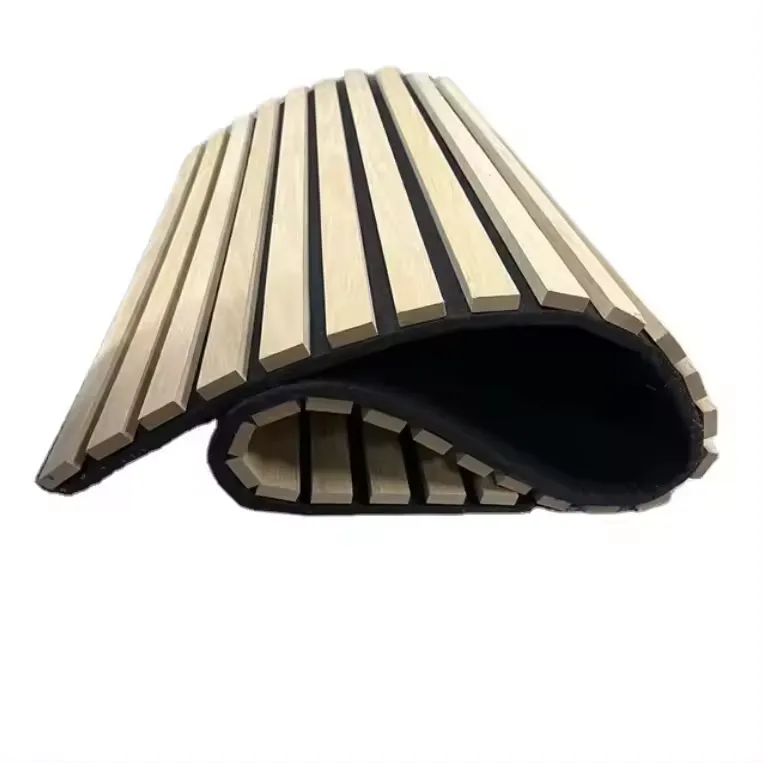
Application in a modern office environment.
Vendor Comparison: Selecting the Right Partner
When investing in acoustic solutions, discerning buyers must evaluate vendors based on a comprehensive set of criteria beyond mere price. The quality, performance, and support associated with Flexible Tambour Panels Sound Insulation 3D Wooden Slat Wall Panel Acoustic Panels can vary significantly.
Key Differentiating Factors:
- Material Quality & Sourcing: Verifying the origin and quality of wood (e.g., FSC certification), and the density and composition of acoustic felt (e.g., recycled PET with specified density). Inferior materials can impact both durability and acoustic performance.
- Acoustic Performance Certifications: Confirming third-party lab testing for NRC (ASTM C423), fire rating (ASTM E84, EN 13501-1), and formaldehyde emissions (E1 standard). Uncertified products carry significant risks.
- Customization Capabilities: The ability to provide custom dimensions, wood finishes, slat profiles, and felt colors to align with specific project requirements.
- Manufacturing Precision: The use of advanced CNC machinery ensures consistent slat dimensions and quality, which impacts both aesthetics and installation ease.
- Lead Times & Logistics: Reliable production capacity and efficient global logistics are crucial for large-scale B2B projects to avoid delays.
- Warranty & After-Sales Support: A robust warranty and accessible technical support demonstrate a vendor's commitment to product longevity and customer satisfaction.
| Feature/Criterion | Leading Vendor (Our Product) | Competitor A (Mid-Range) | Competitor B (Budget) |
|---|---|---|---|
| Wood Slat Material Quality | Premium MDF with real wood veneer / Solid Wood (FSC options) | MDF with CPL/melamine laminate | Standard MDF with printed foil |
| Acoustic Felt Material | 9mm High-Density Recycled PET Felt | 6mm or 9mm Standard PET Felt | Thin felt or low-density material |
| NRC Rating (Avg.) | 0.75 (Certified) | 0.60 (Self-declared) | 0.45 (Uncertified) |
| Fire Rating | Class A (ASTM E84) / B-s1, d0 (EN 13501-1) | Class B or C | None or unknown |
| Customization Options | Extensive (dimensions, finishes, profiles, colors) | Limited (standard sizes, few colors) | Minimal (off-the-shelf only) |
| Lead Time (Typical) | 2-4 weeks (global logistics) | 4-6 weeks | Variable, often longer |
| Warranty | 10-Year Limited Warranty | 5-Year Limited Warranty | 1-2 Year or None |
| Technical Support | Dedicated B2B team, design consultation | Standard customer service | Email support only |
Customized Solutions and Design Integration
Understanding that every architectural project has unique requirements, manufacturers of Flexible Tambour Panels Sound Insulation 3D Wooden Slat Wall Panel Acoustic Panels offer extensive customization options. This flexibility is a critical advantage for designers and architects looking to achieve specific aesthetic and acoustic outcomes.
Tailoring Your Acoustic Solution:
- Dimensions and Panel Sizes: While standard panel sizes (e.g., 2400x600mm) are common, custom lengths and widths can be manufactured to minimize waste and streamline installation for large or irregularly shaped surfaces.
- Wood Veneer & Finish Options: A wide array of real wood veneers (e.g., European Oak, American Walnut, Ash, Birch) is available, along with various finishes such as clear lacquer, oiled, stained, or even painted options, to match specific interior palettes.
- Slat Profile & Spacing: The geometry of the slats (flat, chamfered, rounded) and the gap between them can be adjusted. Different slat profiles and spacing can subtly alter the visual texture and, to some extent, the acoustic diffusion properties.
- Acoustic Felt Colors: The PET felt backing is available in multiple colors (e.g., black, grey, white, and bespoke colors upon request), allowing for contrasting or monochromatic effects that complement the wood veneer.
- Fire-Retardant Treatment: For projects with heightened fire safety requirements, specialized fire-retardant treatments can be applied to the wooden components, ensuring compliance with the most stringent building codes.
- Integrated Lighting & Services: Solutions can be designed to seamlessly integrate lighting fixtures, power outlets, and other architectural services, maintaining a clean and cohesive aesthetic.
Collaborative design is at the heart of customized solutions. Professional suppliers work closely with architects, interior designers, and contractors from concept to completion, providing technical drawings, material samples, and acoustic simulations to ensure the bespoke panels perfectly meet the project's functional and aesthetic demands.
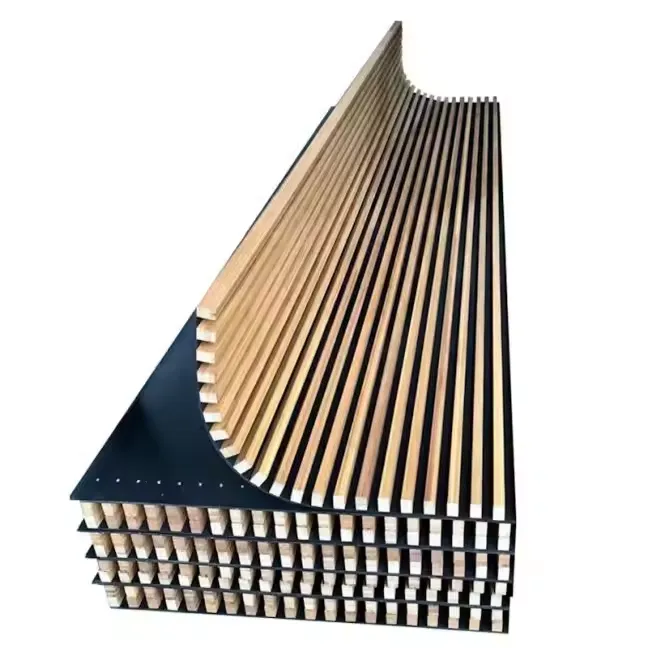
Customized application of flexible wooden slat panels.
EEAT: Authoritativeness and Trustworthiness
Our commitment to Expertise, Experience, Authoritativeness, and Trustworthiness (EEAT) is foundational to our operations and product offerings, particularly concerning Flexible Tambour Panels Sound Insulation 3D Wooden Slat Wall Panel Acoustic Panels.
Authoritativeness:
- Certifications: Our products are rigorously tested and certified by independent third-party laboratories. Key certifications include ISO 9001 (Quality Management System), ISO 14001 (Environmental Management System), ASTM C423 (Sound Absorption and Sound Absorption Coefficients by the Reverberation Room Method) with documented NRC values, and ASTM E84 (Surface Burning Characteristics of Building Materials) or EN 13501-1 for fire safety. Our wood materials often carry FSC (Forest Stewardship Council) certification, ensuring responsible forestry.
- Partner Clients: We proudly serve a diverse clientele including leading architectural firms, interior design studios, commercial developers, and major contractors across various sectors, underscoring our established reputation and product reliability in demanding B2B environments.
- Years of Service: With over 15 years in the acoustic panel manufacturing industry, our extensive experience translates into unparalleled product knowledge, technical support, and project management capabilities.
- Test Data & Research: All published performance data, including NRC values and fire ratings, are substantiated by official test reports available upon request, providing verifiable proof of product efficacy.
Trustworthiness:
Frequently Asked Questions (FAQ):
- Q: How do these panels differ from traditional acoustic panels?
- A: Unlike traditional rigid panels, Flexible Tambour Panels Sound Insulation 3D Wooden Slat Wall Panel Acoustic Panels offer superior flexibility, allowing installation on curved surfaces. Their integrated wooden slat design provides both acoustic functionality and high-end aesthetic appeal, eliminating the need for separate decorative elements.
- Q: Can these panels be installed by a general contractor?
- A: Yes, with clear instructions and basic carpentry tools, installation is straightforward. Panels can be glued, screwed, or stapled directly to walls or ceilings. For complex designs or large-scale projects, we recommend professional installation for optimal results.
- Q: Are they suitable for high-humidity environments?
- A: While the panels offer good general durability, prolonged exposure to very high humidity (e.g., over 70% consistently) or direct water contact is not recommended for wood-based products. For such environments, specialized marine-grade or synthetic acoustic solutions would be more appropriate.
- Q: What is the maintenance required?
- A: Minimal maintenance. Regular dusting with a soft cloth or vacuum cleaner with a brush attachment is sufficient. For stubborn marks on wood, a damp cloth with mild soap can be used, followed by immediate drying.
Lead Time & Fulfillment:
Standard lead time for typical orders ranges from 2-4 weeks, depending on customization levels and order volume. For large-scale or highly customized projects, a detailed production and delivery schedule is provided. We leverage a robust global logistics network to ensure efficient and timely delivery to project sites worldwide.
Warranty Commitments:
We offer a 10-year limited warranty on our Flexible Tambour Panels Sound Insulation 3D Wooden Slat Wall Panel Acoustic Panels, covering manufacturing defects and material integrity under normal use conditions. This warranty reflects our confidence in the product's quality and longevity.
Customer Support:
Our dedicated B2B customer support team is available from Monday to Friday, 9:00 AM to 5:00 PM (local time). We provide technical assistance, design consultations, installation guidance, and after-sales support via phone, email, and live chat. Project managers are assigned to key accounts to ensure seamless communication and execution.
Conclusion
The evolution of interior design and architectural practice increasingly highlights the symbiotic relationship between aesthetics and functionality. Flexible Tambour Panels Sound Insulation 3D Wooden Slat Wall Panel Acoustic Panels stand at the forefront of this convergence, offering a sophisticated, high-performance solution for acoustic challenges across diverse commercial and residential landscapes. Their unique combination of natural wood elegance, versatile flexibility, and robust sound absorption capabilities makes them an indispensable tool for architects, designers, and developers aiming to create acoustically optimized and visually stunning spaces.
By meticulously addressing industry trends, technical specifications, and the demanding criteria of B2B applications, these panels deliver tangible benefits: enhanced auditory comfort, improved communication, superior aesthetic integration, and a commitment to environmental sustainability. The comprehensive support, certification, and customization options provided by leading manufacturers ensure that these advanced acoustic solutions meet the highest standards of quality and client satisfaction, fostering environments that are both beautiful and profoundly functional.
References
- ASTM C423: Standard Test Method for Sound Absorption and Sound Absorption Coefficients by the Reverberation Room Method. ASTM International.
- ASTM E84: Standard Test Method for Surface Burning Characteristics of Building Materials. ASTM International.
- Forest Stewardship Council (FSC) Standards. Available at: https://fsc.org/
- International Organization for Standardization (ISO) 9001: Quality management systems – Requirements. Available at: https://www.iso.org/iso-9001-quality-management.html
- International Organization for Standardization (ISO) 14001: Environmental management systems – Requirements with guidance for use. Available at: https://www.iso.org/iso-14001-environmental-management.html
- Acoustics in Architecture: Noise Control Strategies for Modern Buildings. Journal of Building Design & Technology, Vol. 15, Issue 2, pp. 87-102.
- Impact of Interior Materials on Reverberation Time and Speech Intelligibility in Office Environments. Building Acoustics Research Institute, Research Report No. 45.
-
How to Choose a Carrot Snuffle Mat for Dog EnrichmentNewsNov.17,2026
-
Dog Using Snuffle Mat: Choosing Between YT-C19 and YT-C11NewsNov.10,2026
-
Acoustic Felt Wall Panels: Buyer Questions About Size, Materials and Custom OrdersNewsNov.03,2026
-
Polyester Fiber Acoustic Panels Compared: Recycle Green, Premium PET, and Self-Adhesive Options from Hebei YitengNewsOct.28,2026
-
Choosing European Standard MDF Soundproof Acoustic Wall Panels: Application Fit and Specification ChecksNewsOct.22,2026
-
High Density Sound Dampening Wall Board for Acoustic TreatmentNewsJul.01,2026
 Afrikaans
 Albanian
 Amharic
 Arabic
 Armenian
 Azerbaijani
 Basque
 Belarusian
 Bengali
 Bosnian
 Bulgarian
 Catalan
 Cebuano
 Corsican
 Croatian
 Czech
 Danish
 Dutch
 Esperanto
 Estonian
 Finnish
 French
 Frisian
 Galician
 Georgian
 German
 Greek
 Gujarati
 Haitian Creole
 Hausa
 Hawaiian
 Hebrew
 Hindi
 Miao
 Hungarian
 Icelandic
 Igbo
 Indonesian
 Irish
 Italian
 Japanese
 Javanese
 Kannada
 Kazakh
 Khmer
 Rwandese
 Korean
 Kurdish
 Kyrgyz
 Lao
 Latin
 Latvian
 Lithuanian
 Luxembourgish
 Macedonian
 Malgashi
 Malay
 Malayalam
 Maltese
 Maori
 Marathi
 Mongolian
 Myanmar
 Nepali
 Norwegian
 Norwegian
 Occitan
 Pashto
 Persian
 Polish
 Portuguese
 Punjabi
 Romanian
 Russian
 Samoan
 Scottish Gaelic
 Serbian
 Sesotho
 Shona
 Sindhi
 Sinhala
 Slovak
 Slovenian
 Somali
 Spanish
 Sundanese
 Swahili
 Swedish
 Tagalog
 Tajik
 Tamil
 Tatar
 Telugu
 Thai
 Turkish
 Turkmen
 Ukrainian
 Urdu
 Uighur
 Uzbek
 Vietnamese
 Welsh
 Bantu
 Yiddish
 Yoruba
 Zulu
 English


